
Formulation Science
Carrier choice, release timing, and dose consistency determine whether a stabilized compound becomes a usable product or stays a lab result.
Why formulation
Formulation builds on stabilization, not the other way around.
Without molecular integrity preserved upstream, no carrier system will produce consistent delivery. The formulation layer assumes stabilization has done its job, then shapes how the protected compound reaches the target site, at the right time, at the right dose.
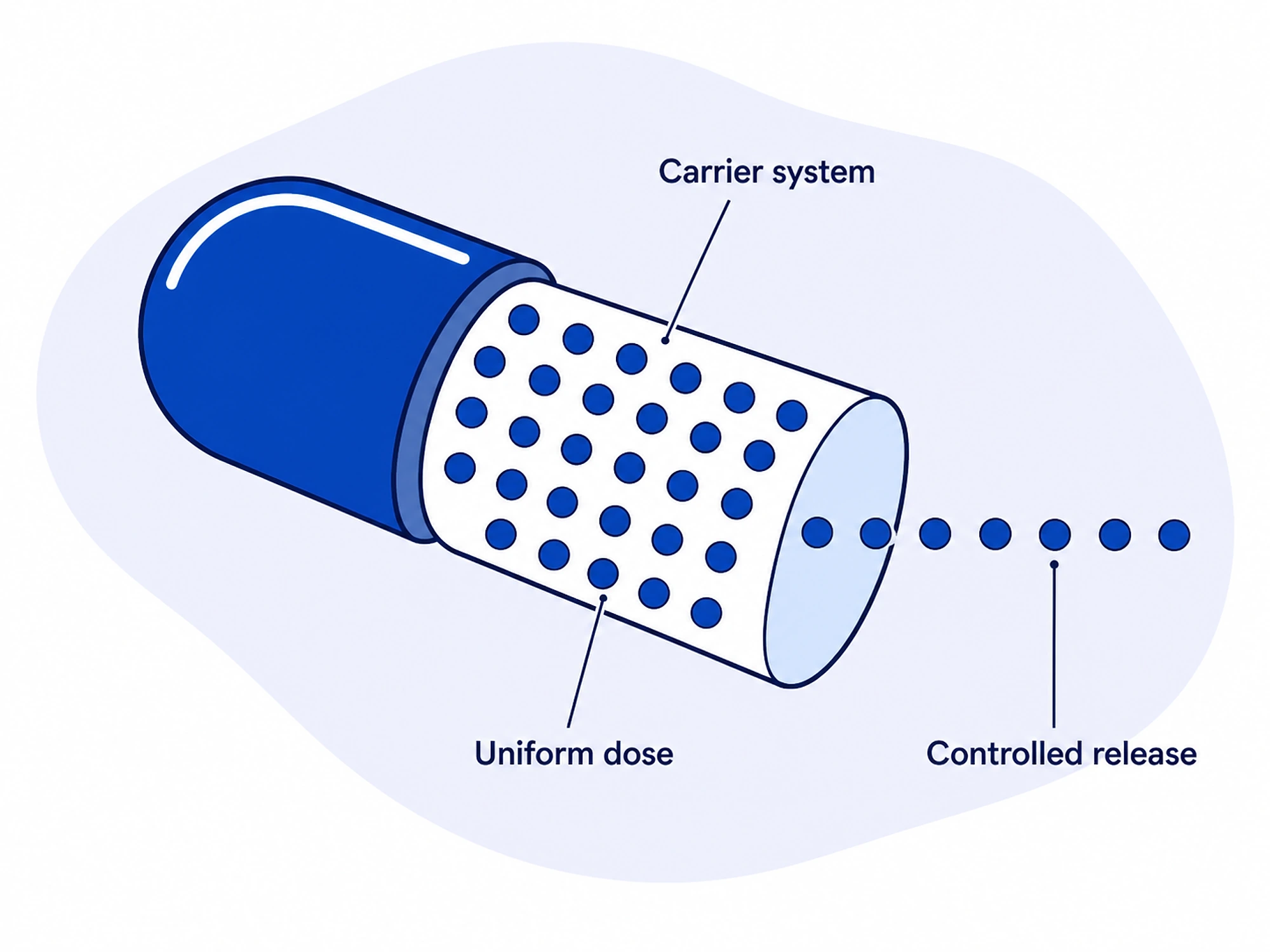
What formulation controls.
Formulation is where molecular preservation becomes product behavior. Each capability shapes how a compound performs at the point of use.

Carrier system design
Carrier architecture is matched to each compound's physicochemical profile, optimizing encapsulation efficiency and protecting the active through processing and storage.

Release profile engineering
Immediate, sustained, and targeted release behaviors are designed into the carrier matrix and validated against dissolution benchmarks before scale-up.

Dose uniformity control
Content uniformity is verified across every batch to ensure consistent active delivery from unit to unit, meeting commercial-grade specifications.

Scale-ready architecture
Formulation decisions are made with manufacturing transfer in mind, so the transition from lab to production does not require redesign.
Where formulation sits in the platform sequence.
Formulation is the third step. It inherits a qualified, protected active and turns it into repeatable delivery behavior.
Incoming material is characterized for identity, potency and purity before any downstream variable is introduced.
Stabilization reduces the degradation pathways that silently erode potency and partner confidence.
Formulation architecture converts preserved actives into repeatable delivery behavior and dosing logic.
Analytics and documentation make the full system legible in diligence, licensing, and transfer conversations.
Formulation questions
The formulation layer shapes carrier choice, release timing, dose consistency, and compatibility with manufacturing transfer, all building on the molecular integrity preserved by Stabilization.
No. The platform can be configured around immediate, sustained, or more targeted release behavior depending on the program need.
Release behavior has to be measured, not assumed. Analytical validation is what makes formulation decisions credible and supports regulatory requirements for reproducibility.